
The Fitness-Performance Connection: Why Employee Wellbeing Is a Business Strategy
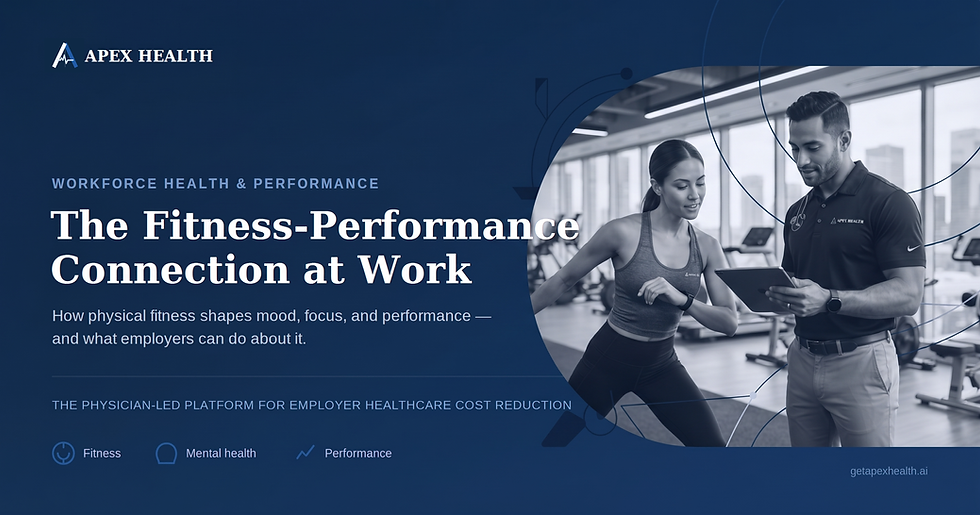
A workforce that feels good in its body tends to perform better at the desk — that connection shows up consistently in occupational health research, and it's one employers are increasingly acting on.
What the research shows
The link between physical activity and job performance isn't a wellness-industry talking point — it's been studied directly. Researchers presenting at the American College of Sports Medicine found that employees who exercised reported roughly a 15% improvement in overall performance on the days they worked out, with better time management, sharper mental focus, and an easier time hitting deadlines.
A separate study from the HealthPartners Research Foundation, published in the Journal of Occupational and Environmental Medicine, found that employees with moderate, regular physical activity had higher-quality work output, took fewer sick days, and reported getting along better with coworkers than their more sedentary peers.
The mechanism isn't mysterious. Exercise improves sleep quality, raises energy levels, and sharpens focus — and researchers have found the effect often shows up the day after exercise, not just immediately during it, in the form of better task performance and creativity.
The mood connection
Fitness and mood aren't separate conversations — they're the same conversation. Regular physical activity is one of the most consistently supported non-clinical interventions for improving mood, reducing anxiety, and easing symptoms of depression. And mood, in turn, is a direct input into how people show up at work: how patient they are with colleagues, how they handle a stressful client call, whether they finish the week running on empty or with something left in the tank.
That link matters at the balance-sheet level, too. Gallup research has found that employees who rate their mental health as "fair" or "poor" report roughly four times more unplanned absences than colleagues in good mental health — a pattern researchers estimate costs the U.S. economy in the tens of billions of dollars a year in lost productivity. Poor mental health doesn't stay contained to the person experiencing it; it shows up in missed days, disengaged meetings, and turnover.
Put simply: a body that's cared for supports a mind that's steadier, and a workforce with steadier minds performs — and stays — better.
Where employers come in
None of this means employers need to become fitness coaches. It means physical and mental health can no longer be treated as two separate line items in a benefits package — they move together, and the employers who treat them that way tend to see it reflected in engagement, retention, and cost.
This is the thinking behind how Apex Health is built. As a physician-led platform, Apex Health pairs 24/7 virtual primary and urgent care with one-to-one behavioral health support and physician-guided weight management — so an employee dealing with low energy, disrupted sleep, or a stalled fitness goal has a real, licensed clinician to talk to, not just a wellness app to ignore. It's whole-person support, delivered through the same platform, so care for the body and care for the mind aren't competing for attention — they're coordinated.
For employers, that coordination is the point: healthier habits, supported consistently, tend to show up as fewer sick days, steadier performance, and a workforce with more to give.
Where to start
If your organization is exploring how physical fitness support fits into your broader benefits strategy, Apex Health's physician-led weight management program is a practical place to begin — built around sustainable habits, not quick fixes, and backed by the same clinical team behind Apex Health's virtual care and behavioral health services.


Comments