
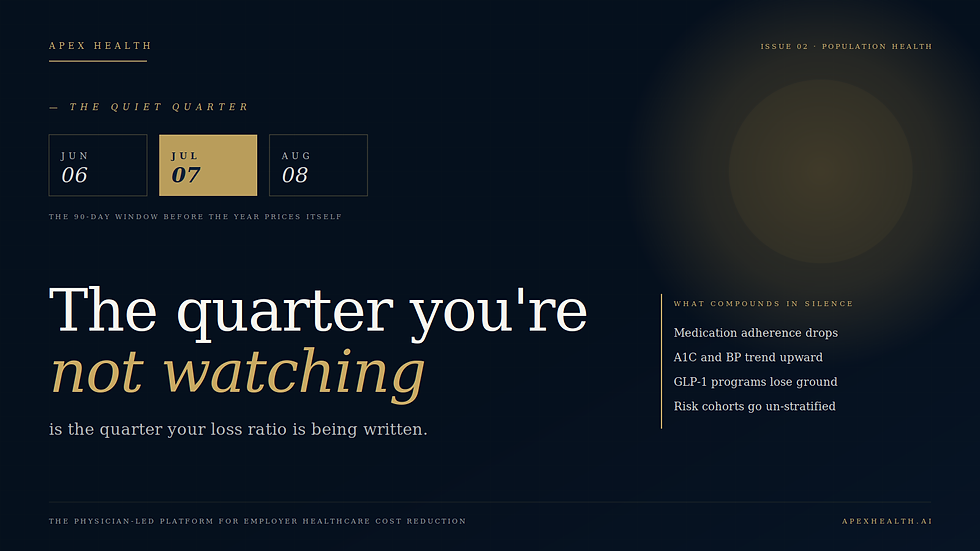
The quarter you're not watching
— THE QUIET QUARTER -
is the quarter your loss ratio is being written. Your highest-cost employees aren't getting worse in January — they're getting worse right now.
Open enrollment is months away. The HR team is running on PTO coverage. Wellness programming has gone quiet. And the top 5% of your claims spend is quietly deteriorating in the background.
Summer is the most under-managed quarter in employer healthcare. And it is the quarter where next year's renewal is actually being written.
The employees driving your highest-cost claims — uncontrolled diabetes, untreated hypertension, the early-stage cardiac risk no one has flagged yet, the GLP-1 patients whose adherence is slipping — are not waiting for January to deteriorate. They are deteriorating now, in the months when the benefits team is least equipped to see it.

What happens between June and September.
Three things compound at once during the summer months, and all three are invisible to a benefits team waiting for the open-enrollment cycle to begin.
Heat compounds chronic conditions — hypertension destabilizes, cardiovascular load increases, kidney function in at-risk patients deteriorates. Travel disrupts medication adherence; refill rates measurably drop in July and August. Vacation eating patterns spike A1C and blood pressure in employees who were already trending the wrong way before they left the office.
By the time September arrives and someone finally schedules a physical, the damage is already on the books — and it shows up in Q4 claims, which lock into next year's renewal math before the negotiation conversation even begins.
Three moves that actually shift the curve.
For HR directors and benefits managers running a self-funded or level-funded population, the next 90 days are not passive. They are the most leveraged 90 days of the plan year — because the cost of an avoidable Q3 deterioration shows up in the Q4 loss ratio, and the Q4 loss ratio prices the renewal.
Three operational moves matter more than anything else between now and Labor Day:
01
STRATIFY NOW, NOT AT RENEWAL
Identify your highest-cost employees in claims data today.
The employees who will drive your Q4 claims are visible in current-quarter claims data right now. Predictive risk modeling identifies rising-risk cohorts in weeks, not quarters. By the time renewal underwriting begins, those employees are already in an outreach workflow — not a surprise on the loss ratio.
02
FRICTIONLESS CARE WHEN IT'S HARDEST TO GET
Make access easy in the months when employees actually need it.
24/7 virtual access matters most during the months when employees are traveling, on vacation, or putting off the appointment they will not schedule until October. A 15-minute virtual urgent care consult in July prevents the ER claim in September. Friction during the summer becomes claims dollars in the fall.
03
DON'T LOSE SIX MONTHS OF PROGRAM INVESTMENT
Get ahead of GLP-1 utilization and adherence patterns.
Summer is when adherence drops, prescriptions lapse, weight regain accelerates, and chronic-condition programs lose ground. An unmanaged GLP-1 cohort in July is a renewed cost-driver in November. Physician-managed oversight and continuous monitoring during the quiet quarter protect the investment that has already been made.
The Q4 surprise is preventable. It's also predictable.
Every CFO conversation in November and December includes some version of the same line: "We didn't see this coming." It is almost never true. The signal was there in June. The signal was there in July. The data was visible. The intervention window was open. The benefits team was on PTO coverage.
The cost of a passive summer shows up in November, when the loss ratio is already locked and the renewal is already priced. The employers who treat July as a clinical quarter — not a quiet one — are the ones whose CFOs are not surprised in Q4.
What changes when summer becomes operational.
Apex Health's predictive risk stratification runs continuously across the population, flagging rising-risk employees in real time. 24/7 ER-trained virtual primary and urgent care is available the moment an employee needs it, anywhere they happen to be. Physician-led integrated care management keeps GLP-1 cohorts, chronic-condition populations, and behavioral health patients connected to care during the months when most programs go dormant.
The framework is straightforward: Predict, Care, Integrate. The clinical layer sits underneath your existing carrier and broker — it does not replace them. It changes the claims signal those entities are pricing against.
In typical client cohorts, the cumulative effect is 30 to 50 percent reduction in avoidable claims, 8.5x ER diversion, and a 45 percent reduction in readmissions — outcomes that are not driven by negotiating harder, but by intervening earlier.
Note on figures. Outcome ranges (claims reduction, ER diversion multiples, readmission reduction) reflect typical Apex Health client cohorts and modeled steady-state engagement.
Results vary by population, plan structure, and engagement levels. This article is informational and does not constitute medical advice; clinical decisions should always be made between an employee and a licensed clinician.
For non-emergencies, virtual care is the appropriate first contact — for true emergencies, call 911.
Apex Health - The physician-led platform for employer healthcare cost reduction.


Comments